Arkansas Plant Hardiness Zones: Finding Your Growing Zone by ZIP
Finding your Arkansas growing zone by ZIP code can help narrow plant choices, but it cannot tell you exactly when to plant or how a plant will fare in your yard. The key is using the zone as one planning tool, then accounting for local cold, exposure, soil, and spring freeze risk.
What a plant hardiness zone tells you
A plant hardiness zone is a way to compare winter cold conditions with the cold tolerance of perennial plants. It is most useful when you are choosing trees, shrubs, and perennials that will remain outdoors through winter. A plant label or catalog may give a hardiness range; comparing it with your map result helps you judge whether the plant is a reasonable candidate for your area.
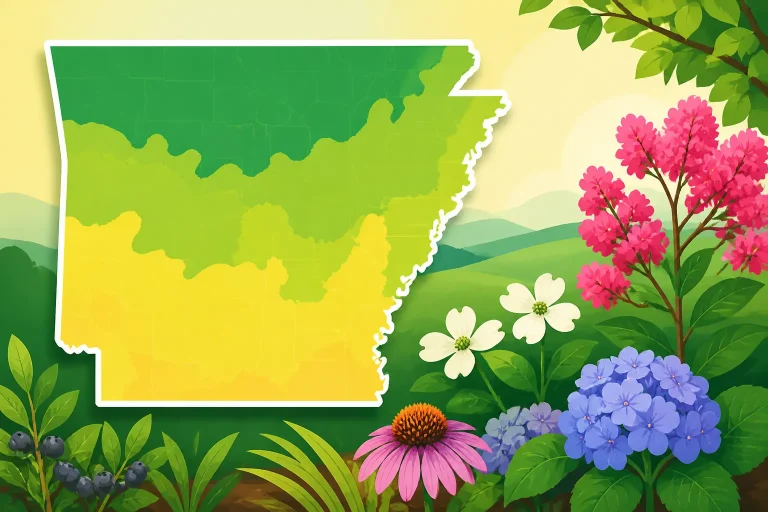
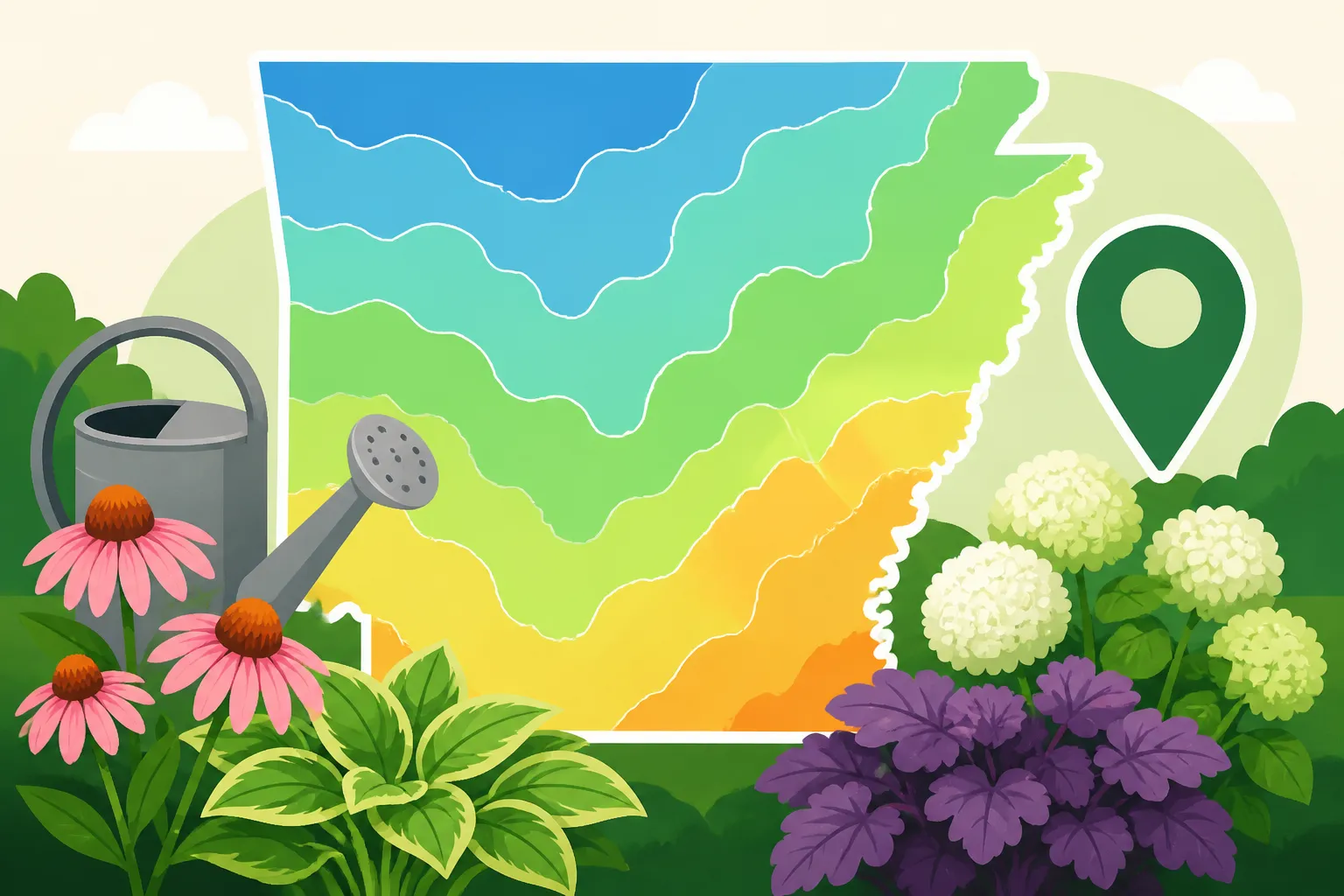
According to the University of Arkansas System Division of Agriculture Cooperative Extension Service, the USDA 2023 map places Arkansas in hardiness zones 7a to 8b. That statewide range is useful context, but it does not mean every yard in Arkansas experiences the same winter conditions.
A ZIP code lookup is a starting point, not a precise measurement of your property. ZIP codes cover areas rather than individual gardens, and a mapped zone is a regional estimate. A result can help you screen plant choices, but it cannot account for every difference between your yard and the nearby locations used to represent the map.
The zone also does not describe every part of a plant’s growing environment. It does not tell you whether a bed is shaded, waterlogged, exposed to drying wind, or slow to drain. Nor does it show whether cold air settles in a low spot or whether a sunny wall makes a planting area warmer than its surroundings.
For practical gardening, think of the zone as a first filter:
- If a plant is well outside the cold tolerance suggested for your location, it may need protection or a different growing setup.
- If a plant is suited to your mapped zone, it is still worth checking its light, soil, moisture, and heat requirements.
- If the plant is sensitive to a late cold snap, the zone alone will not tell you when it is safe to plant it outdoors.
For background on the map’s range and how its labels work, see Reading USDA Zones 7a to 8b on Arkansas’s Plant Hardiness Map. If you are deciding whether the zone can be used as a planting calendar, Can USDA Hardiness Zones Tell Arkansas Gardeners When to Plant? explains why the answer is limited.
How to find a growing zone by ZIP code
A ZIP code search offers a convenient way to start using the USDA Plant Hardiness Zone Map. The result is useful for narrowing plant options, but it should not be treated as a guarantee for a specific address or garden bed.
Use the official USDA map for the lookup. Enter your ZIP code in the map’s search function and review the area around the result, not just the label shown for the ZIP. If the mapped area changes nearby, your location may sit close to a zone boundary. In that case, it is sensible to consider how the plants you are choosing respond to cold and to avoid treating a single map result as an exact property-level reading.
A careful lookup can follow this process:
- Search using your ZIP code on the official map.
- Zoom in enough to see the mapped area surrounding the result.
- Note whether the result appears close to a boundary or within a broader, consistent area.
- Compare the zone information with the cold-hardiness range listed for the plant you are considering.
- Check local planting guidance separately if the question is when to sow seeds or set out transplants.
The final step matters. A ZIP lookup is particularly relevant to plants that stay in the ground through winter. It is not a substitute for a vegetable planting calendar, which needs to account for seasonal timing, crop needs, and the risk of frost. For dates and methods suited to a particular crop, use How to Find Vegetable Planting Dates for Your Arkansas County rather than using the ZIP result as a calendar.
If your ZIP code appears to cross a boundary, avoid making a strong planting decision from the label alone. Look at the garden’s actual setting: whether it is elevated or low, exposed or sheltered, and likely to hold or shed cold air. Those observations may help explain why a plant performs differently in your yard than it does in another part of the same ZIP code.
It can also help to keep the map result with your garden notes. Record the plants that overwinter reliably, the ones that suffer cold injury, and the areas where damage is most common. Over time, those observations give you useful context for interpreting the regional map. They do not replace official hardiness information, but they can make your plant choices more informed.
How to read zone labels and plant descriptions
Plant labels often present cold hardiness as a range or category rather than a promise that a plant will thrive everywhere within that range. Read the label as a clue about winter survival, then consider what else the plant needs. A suitable cold range cannot compensate for poor drainage, too little light, or a planting site that stays wet.
When a plant description includes a hardiness range, compare it with your ZIP-code map result. If your area falls within that range, the plant may be worth considering. If your location is near the colder edge of the plant’s stated tolerance, a sheltered location may improve its chances, though it does not remove the risk of unusually harsh weather.
A useful way to evaluate a plant description is to ask:
- Is this plant intended to remain outdoors through winter, or is it usually grown as a seasonal annual?
- Does the stated hardiness range include the result from your map lookup?
- Is the plant likely to tolerate your yard’s summer conditions as well as its winter cold?
- Does the description specify a preference for sun, shade, dry soil, or consistent moisture?
- Is there a protected location where the plant’s needs can be met?
Hardiness is only one part of matching a plant to a site. A plant can survive winter but grow poorly because it receives unsuitable light or grows in soil that stays wet. Another may thrive in a sheltered bed while struggling in a more exposed part of the same property. These differences are why a zone label is most helpful when read alongside the full plant description.
For a closer look at comparing a plant’s listed tolerance with local conditions, see Checking Plant Cold Hardiness for Your Arkansas Zone. If you are choosing an unfamiliar plant, pay attention to whether the description refers to winter survival, dependable flowering, fruiting, or overall performance. Those are related but not identical expectations.
A plant may survive a cold season and still lose leaves, flowers, or above-ground growth. That does not always mean the plant was mismatched to the zone. It may reflect exposure, a cold snap, wet soil, or the plant’s normal seasonal behavior. Check how the plant is expected to respond before deciding whether visible winter damage means it cannot grow in your yard.
The reverse is also possible: a plant may be listed as suitable for your zone but struggle during a particular winter or after repeated exposure to stressful conditions. Hardiness ranges are useful for making a reasonable choice, not for promising a specific result.
What a hardiness zone cannot tell you
The biggest misunderstanding is treating a plant hardiness zone as a complete planting calendar. It is not. The map helps with questions about winter cold tolerance. It does not identify the best week to plant a vegetable, predict the last cold night in spring, or tell you when soil is ready for a crop.
That distinction is important for Arkansas gardeners because decisions about tender plants often depend on changing spring weather. A plant that can handle the region’s typical winter conditions may still be damaged if it is moved outside before the danger of a late freeze has passed. For that reason, a hardiness zone is not a green light for early outdoor planting.
The map also cannot predict the weather in a particular year. A location may have a relatively mild winter overall and still experience a damaging cold spell. Likewise, a brief cold event can affect plants differently depending on how exposed they are and whether they have begun new growth.
The zone does not account for:
- Spring freeze timing. The map does not give a date when tender seedlings are safe outside.
- Summer heat. Winter hardiness says little about how a plant handles hot weather, strong sun, or drying conditions.
- Soil drainage. Cold tolerance does not mean a plant will tolerate saturated roots.
- Wind exposure. An open, windy yard can stress plants differently from a sheltered site.
- Elevation and slope. Nearby locations can have different cold-air patterns.
- Small-scale shelter. Walls, fences, trees, and nearby buildings can change conditions around a bed.
- Crop maturity. A zone does not tell you whether a vegetable will have time to mature during a particular planting window.
For a fuller explanation of seasonal freeze risk, see Why Updated Hardiness Zones Do Not Eliminate Spring Freeze Risks. For average timing and regional planning, Arkansas Freeze Dates by Zone: Average Spring and Fall Timing is more relevant than a winter-hardiness lookup.
Vegetables need a different kind of timing decision from many trees and shrubs. Some are damaged by frost, while others tolerate cool conditions and are often planted during cooler parts of the year. The right approach depends on the crop, the planting method, and local conditions. A zone lookup alone does not contain those details.
It also does not replace local observation. If a nearby garden is warm and sheltered, it may be tempting to use its planting schedule, but your yard may have a different exposure or drainage pattern. Treat advice from another location as a useful comparison, not an automatic instruction.
Why Arkansas yards can differ from a ZIP-code result
A map is broad by design, while a garden is a small place with its own conditions. Even within one ZIP code, the way a yard handles cold can vary. A sloped bed, low corner, sheltered patio, and open field can experience different conditions during the same weather.
Cold air tends to move downhill and collect in low areas. A garden in a hollow or at the bottom of a slope may be more exposed to cold than a nearby site with better air movement. A slope that allows cold air to drain away may have a different risk profile from a level, enclosed space. This does not let you calculate an exact zone for a bed, but it gives you a reason to watch how cold events affect different parts of the yard.
Buildings and landscape features can matter too. A wall may block wind or release stored warmth, while a gap between buildings may funnel wind. Trees may provide shelter, but their shade can also change how quickly a planting area warms. These features can help one plant and hinder another, depending on the plant’s needs.
Soil and water add another layer. A damp site may remain cooler or stay wet after rain, while a well-drained bed can behave differently. Roots in waterlogged soil may be vulnerable even when the plant is suited to the regional winter climate. A hardiness label does not describe the soil conditions around your plant.
Elevation can also affect local temperature patterns. In a varied landscape, nearby sites may differ in exposure and how quickly they warm. This is one reason a general ZIP-code result should not be read as a precise description of every yard. Adjusting Arkansas Planting Dates by Local Elevation and Microclimate offers more detail on adapting plans to the conditions around a garden.
You can make your own site observations without trying to assign a new official zone:
- Note where frost or cold damage appears first after a cold spell.
- Compare exposed beds with sheltered beds.
- Watch whether low areas stay colder or wetter than slopes.
- Record which plants keep growing well and which repeatedly suffer.
- Notice whether shade, walls, or wind protection change how a planting area performs.
These observations are especially useful when choosing between two suitable planting locations. If a plant is near the edge of its cold tolerance, placing it in a sheltered, well-drained area may be a more reasonable choice than putting it in an exposed low spot. However, no microclimate adjustment makes a plant immune to severe or unusual weather.
Keep the map result and your yard notes separate. The map describes a regional category; your notes describe what you have observed in your own growing spaces. Both are useful, but they answer different questions. Avoid presenting a personal observation as a revised official zone.
Use your zone as part of a planting plan
A sound planting plan combines hardiness information with season-specific guidance. Start with the plant’s needs, identify whether it is a perennial or a seasonal crop, then use the right kind of calendar for the decision you need to make.
For a tree, shrub, or perennial, use the zone lookup to screen for winter suitability. Then check the plant’s preferences for sun, soil, moisture, mature size, and exposure. If it is a high-value or less cold-tolerant plant, think carefully about the planting location and the potential need for protection. A favorable map result is not a reason to ignore the site.
For vegetables, begin with the crop rather than the zone. Look for planting guidance that distinguishes between cool-season and warm-season crops, and between direct sowing and transplanting. The best approach may differ even among vegetables planted in the same bed. Direct Sowing vs Transplants: Choosing the Right Start for Crops can help with that choice.
Use a calendar made for the task at hand. A general planting calendar can organize seasonal work, while a crop-specific guide can address sowing windows or transplant decisions. For broader seasonal planning, Arkansas Vegetable Sowing Calendar: Spring and Fall Planting is more useful than a ZIP-code zone result. For a larger overview of crop timing and maturity, see Arkansas Year-Round Planting Calendar and Crop Maturity Days.
| Gardening question | Use the zone lookup? | What else to check |
|---|---|---|
| Is a perennial a reasonable winter-hardiness candidate? | Yes, as an initial screen | Plant description, drainage, exposure, and shelter |
| Is it safe to set out a tender vegetable now? | No, not by itself | Crop-specific planting guidance and current freeze risk |
| Will a plant tolerate summer heat or strong sun? | No | Sun exposure, moisture needs, and heat tolerance |
| Is a vegetable suited to direct sowing or transplanting? | No | Crop guidance and the condition of the growing space |
| Could a plant struggle in a low, wet part of the yard? | The map does not answer this | Drainage, cold-air movement, and local observations |
It helps to plan in layers rather than trying to find one number that answers every question. Start with regional hardiness, then check the specific plant, then look at seasonal guidance, and finally consider the conditions in your yard. If any of those signals conflict, investigate before planting a large area.
For example, a plant description may suggest winter suitability, but the intended location could have poor drainage. Or a vegetable calendar may indicate a seasonal window, while a forecast points to a possible cold event. The zone cannot resolve either situation by itself. Use the information that matches the problem: hardiness for winter survival, a planting calendar for seasonal timing, and site assessment for local growing conditions.
Keep records of what you plant and where you place it. Note whether a plant comes through winter, whether it suffers after a freeze, and whether it performs differently in sheltered and exposed beds. Records can help you make better choices next season, especially if you are deciding whether to repeat a plant or try a more suitable location.
Frequently Asked Questions
Does my ZIP code identify the exact hardiness zone for my yard?
No. A ZIP-code lookup is a convenient way to see the map around your location, but it does not measure the conditions in an individual yard. Use the result as regional guidance, then consider exposure, slope, drainage, and shelter.
Can I use my growing zone to decide when to plant vegetables?
Not by itself. The zone is mainly useful for comparing perennial plants’ winter cold tolerance. Vegetable planting decisions need crop-specific seasonal guidance and attention to spring freeze risk.
If a plant matches my zone, is it guaranteed to thrive?
No. A suitable hardiness range is only one part of plant selection. Sun, soil, water, wind, and local cold patterns can all affect performance.
What should I do if my ZIP code is near a zone boundary?
Check the map around the result and treat the boundary as a reason to be cautious, not as a precise dividing line through your yard. For a plant near the edge of its listed tolerance, favor a suitable sheltered site and consider how it has performed locally.
Disclaimer
This article is for general informational purposes only and does not constitute professional advice. Laws, prices and regulations vary by location and change over time. Consult a qualified professional for guidance on your specific situation. Arkansas Gardening Guide is not a government agency and is not affiliated with any university extension, state department of agriculture or other government agency.