Direct Sowing vs Transplants: Choosing the Right Start for Crops
Choosing between seeds sown in the garden and seedlings started indoors can affect how well a crop establishes, how much work it takes, and when you harvest. Arkansas gardeners also have to account for changing spring weather, summer heat, and differences between regions. The right method depends on the crop, the soil, and the time you can give it.
What direct sowing and transplanting mean
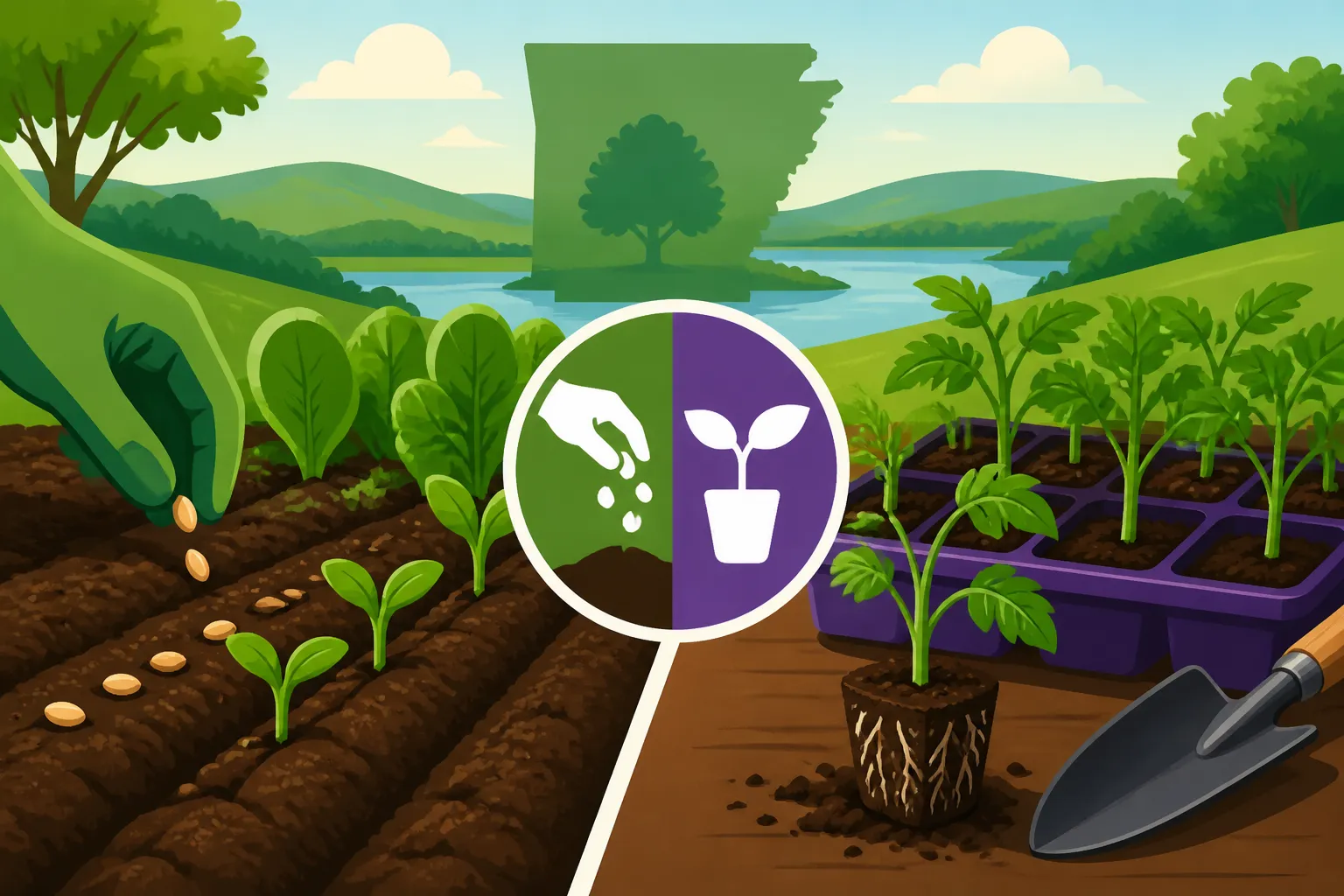
Direct sowing means planting seeds where the crop will grow to maturity. Transplanting means raising a seedling in a container or buying one, then moving it into the garden. Some crops do well either way; others are much more reliable with one method.
The choice is not simply about getting a head start. Seeds sown outdoors avoid the stress of being moved, but they depend on suitable soil and weather at planting time. Transplants can give a slow-growing crop a useful start, but moving a seedling can set it back if its roots are disturbed or conditions are harsh.
Arkansas weather makes timing important. A warm, sunny spell in spring does not guarantee that cold nights are over, and a planting date that works in one part of the state may not fit another. Use local conditions, crop needs, and the expected time to maturity together. Arkansas Vegetable Planting Guide: Scheduling Crops by Local Freeze explains how freeze timing fits into a planting plan.
Direct sowing
For direct sowing, seeds go into prepared garden soil at the depth and spacing recommended for the crop. They germinate and grow in place. This avoids transplant shock and saves the time, equipment, and indoor space needed to raise seedlings.
Direct sowing works especially well for crops that germinate quickly, grow rapidly, or dislike having their roots disturbed. It also makes sense for crops that produce many plants from a modest packet of seed, such as beans, radishes, and leafy greens.
The main limitation is that seeds depend on the outdoor bed from day one. Soil that is too cold, too wet, crusted, or dry can delay or prevent germination. Newly emerging seedlings are also exposed to slugs, birds, heavy rain, wind, and abrupt temperature changes. You may need to water gently and consistently while the seedbed establishes.
Transplanting
A transplant starts as a seedling in a pot, cell tray, or nursery container. It moves into the garden after developing enough roots and leaves to handle the change. Transplanting can be a practical way to grow crops that take a long time to mature or need a protected start before outdoor conditions suit them.
A sturdy transplant can save several weeks of outdoor growing time, though it does not make the season longer without limits. A seedling set out too early may stall in cold soil, while one kept indoors too long can become tall, weak, or root-bound. Moving it into the garden also requires a period of adjustment, often called hardening off, so it can cope with outdoor sunlight, wind, and temperature swings.
Which crops usually suit each method
A crop’s root system, germination needs, and growing season all matter. The table below is a starting point, not a rule for every garden. A gardener with a warm, well-drained bed may be able to sow earlier than someone with heavy, cold soil. Follow seed-packet directions for depth, spacing, and crop-specific guidance.
| Crop or crop group | Usually best start | Why it tends to work |
|---|---|---|
| Carrots, beets, and radishes | Direct sow | Roots can be misshapen or set back when disturbed |
| Snap beans and southern peas | Direct sow | They grow quickly in warm soil and generally do not need an indoor head start |
| Sweet corn | Direct sow | Seed can be planted outdoors when soil is warm enough; root disturbance is undesirable |
| Cucumbers and summer squash | Direct sow or transplant | They grow quickly; direct sowing avoids root disturbance, while a transplant can help where the growing window is tight |
| Lettuce and spinach | Usually direct sow; transplanting can also work | They grow readily from seed, and young seedlings can be moved carefully |
| Broccoli, cabbage, and cauliflower | Often transplant | Starting seedlings in a protected place gives these crops time to develop before outdoor conditions suit them |
| Tomatoes and peppers | Usually transplant | They need a long warm growing period and are commonly started indoors or purchased as seedlings |
| Eggplant | Usually transplant | A developed seedling can help the crop get established during warm weather |
| Okra | Direct sow | It grows best after soil warms and can be sown in place |
| Herbs | Depends on the herb | Some establish easily from seed; others are slower or simpler to start as transplants |
For details on crop-specific timing, see Arkansas Vegetable Sowing Calendar: Spring and Fall Planting and Arkansas Year-Round Planting Calendar and Crop Maturity Days. These resources can help match a start method to the crop’s planting window and expected maturity.
Root crops usually prefer to stay put
Carrots, radishes, and beets are common direct-sowing choices because the edible part develops underground. Moving a young plant can disturb or bend the developing root, which may lead to misshapen produce or uneven growth. Root crops also tend to germinate readily when the seedbed is prepared well and kept evenly moist.
Beet seedlings are an exception to the idea that every plant must be thinned to one seed. A beet “seed” is commonly a cluster that can produce more than one seedling. Thin the young plants according to the packet’s spacing directions so each has room to develop. For guidance on timing, see Days to Harvest for Arkansas Spring Carrots, Beets, and Radishes.
Warm-season crops can be sown directly once conditions suit them
Beans, corn, okra, and southern peas are generally sown outdoors after cold conditions have passed and the soil is warm enough for dependable germination. Planting them in chilly ground can result in slow emergence and seed loss, especially if the soil stays wet.
These crops often grow quickly once established, so an indoor start may offer little advantage. Beans and peas can be sensitive to root disturbance, and corn is best planted where it will grow. For crop-specific windows, see Warm-Season Sowing Windows for Tender Crops Across Arkansas, Planting Snap Beans in Arkansas From March Through August, and Sowing Fall Southern Peas in Arkansas From Mid-July to August.
Slow-growing warm-season crops often benefit from transplants
Tomatoes, peppers, and eggplant are usually managed as transplants because they take time to grow and need warm weather to thrive. Starting them indoors can give seedlings a useful head start, while buying healthy plants can reduce the equipment and daily care needed at home.
The head start only helps when the seedlings are ready for outdoor conditions. If the bed is still cold or nights are unsettled, a transplant may sit without growing much. For more on growing these crops from seed and moving them outside, see Indoor Seed Starting Dates for Arkansas Tomatoes and Peppers and Pepper Seed Starting Indoors and When Arkansas Soils Warm Enough.
Brassicas are often raised as transplants
Broccoli, cabbage, and cauliflower are commonly started in containers or purchased as seedlings. The method gives them a chance to develop before taking up garden space, and it can make succession planting easier when you want to place a small number of plants at intervals.
These crops can also be direct sown in suitable conditions, but small seedlings need consistent moisture and protection from heat and pests. Transplanting is not automatically better: plants that are too old, root-bound, or stressed may establish poorly. See When to Transplant Broccoli, Cabbage, and Lettuce in Arkansas for more detail.
How to choose for your garden
A useful choice starts with the crop, then accounts for your soil, space, and schedule. Rather than deciding that one method is always easier, consider what can go wrong with each method in your conditions.
Use direct sowing when outdoor conditions are ready
Direct sowing is a good option when the crop grows quickly, does not like root disturbance, or can be planted during a suitable outdoor window. It is also convenient when you do not have a sunny indoor space or want to avoid managing lights, trays, and watering.
Before sowing, make sure the soil is workable rather than saturated. A fine, level seedbed helps small seeds make good contact with the soil. Follow packet directions for sowing depth; burying small seeds too deeply can prevent emergence. Water gently so the seeds are not displaced or washed into clumps.
The seedbed should stay evenly moist while seeds germinate. This may mean checking it more often than a bed with established plants, especially during windy or warm weather. A thin cover of an appropriate material can help reduce drying, but it should not block seedlings from emerging. Avoid letting the surface form a hard crust, which can be a barrier for small seedlings.
Use transplants when a protected start helps
Transplants are useful when you want to grow a crop that takes a long time to mature, when outdoor conditions are not yet suitable for germination, or when it is helpful to place a known number of plants at measured spacing. They can also make a garden plan more flexible: a bed can hold an earlier crop before a later set of transplants goes in.
If starting seedlings indoors, provide enough light and space for compact growth. Crowded, dim conditions can produce thin stems and tangled roots. Water consistently, but do not leave trays sitting in water. As plants approach planting time, gradually expose them to outdoor conditions. Start with a protected period and increase exposure over several days, adjusting for strong sun, wind, and temperature.
A seed company such as Botanical Interests may provide crop-specific instructions on its seed packets. Use those directions as a starting point, then adapt the timing to local soil and weather. If a seedling is already growing well in a container, check that its roots are not packed tightly before planting.
Choose a healthy transplant
A good transplant is generally sturdy and well balanced, with healthy leaves and roots that fill the container without forming a dense, tangled mass. Avoid choosing plants that look wilted, badly damaged, or stretched and weak. A plant with flowers or fruit already forming is not necessarily a better choice; it may be under stress or have spent energy before it has settled into the garden.
Before planting, water the seedling so its root ball is moist and easier to handle. Set it at the depth appropriate for that crop, firm the soil gently around it, and water it in. Keep the surrounding soil from drying out while the roots begin to grow into the bed. Avoid rough handling, and do not pull a seedling out by its stem.
Some crops, including tomatoes, can form roots along buried portions of the stem, but planting depth is crop-specific. Do not assume that every transplant should be buried deeply. Follow reliable crop directions rather than using one planting technique for everything.
Account for soil, bed, and weather
Arkansas gardens range from sandy soils to heavy clay, and conditions within a yard can vary too. Clay that remains wet may warm slowly and can be difficult to work early in the season. In that situation, sowing or transplanting into saturated soil can compact the bed and limit seedling establishment. Wait until the soil is workable, or use a well-prepared raised bed if that suits the site.
Raised beds and containers can warm and drain differently from in-ground soil. That may change when a bed is ready for planting, but it does not remove the need to consider frost and crop temperature needs. An exposed garden also faces more wind and temperature variation than a sheltered spot beside a building or fence.
Hardiness zones describe the average coldest winter temperatures in an area; they do not tell you whether a particular spring day is safe for planting. Can USDA Hardiness Zones Tell Arkansas Gardeners When to Plant? explains why planting dates also depend on freeze risk and crop needs.
Plan for the whole season, not just the first planting
A direct-sown crop may be ready sooner than expected, while a transplant may take time to recover from being moved. Use the seed packet’s maturity estimate as a planning aid, not a guaranteed harvest date. Weather, soil, water, and plant stress can all affect the actual time to harvest.
For fall crops, the time available before cold weather matters as much as the method. A transplant can be useful when a crop needs time to establish, while direct sowing may be appropriate for crops that mature quickly and tolerate the available conditions. Plan backward from the expected end of the growing window, and allow for establishment and harvest. Planning a Second Harvest With Arkansas Fall Vegetables and Calculating Arkansas Growing Season Length for Fall Crop Harvests can help with that planning.
A practical process for deciding
When you are unsure how to start a crop, work through these steps before planting.
- Check the crop’s preferred method. Look at seed-packet instructions or a reliable crop-specific guide. Note whether the crop is commonly sown in place or transplanted.
- Check the outdoor conditions. Consider current soil moisture and temperature, the forecast, and whether the bed is exposed or sheltered. Do not use one warm afternoon as proof that conditions are settled.
- Consider the time to maturity. A crop that needs a long warm period may benefit from a transplant. A fast crop that dislikes root disturbance often does not need one.
- Assess your setup. If you can provide adequate indoor light and care, starting seedlings may be practical. If not, direct sowing or buying a few sturdy transplants may be simpler.
- Prepare the bed for the method. Direct sowing requires a fine seedbed and reliable moisture. Transplanting requires careful handling, suitable spacing, and time for plants to adjust.
- Keep track of results. Note the planting date, method, weather, and harvest. A short garden record helps you see which approach works in your own yard and how your soil behaves.
You do not need to choose one method for the entire garden. A mixed approach is often the most practical: direct sow beans, carrots, and radishes, while using transplants for tomatoes, peppers, or brassicas. It spreads out the work and lets each crop use the method that suits it.
Common problems and how to avoid them
Both methods can fail for avoidable reasons. The key is to identify whether the problem begins before planting, during establishment, or after plants have started growing.
Seeds do not emerge
Poor emergence may result from planting too deeply, letting the seedbed dry out, sowing into cold or waterlogged soil, or allowing the surface to crust. Seeds may also be old or have been stored in poor conditions. Check packet instructions, soil condition, and moisture before sowing again. If you replant, avoid placing new seed in a spot that is still saturated or likely to wash out.
Small seeds can be especially hard to sow evenly. Mix them with a little dry sand if appropriate for the crop, or sow carefully in a shallow furrow and thin after emergence. Do not cover tiny seeds with a thick layer of soil unless the directions call for it.
Transplants wilt after planting
Some wilting is possible as a seedling adjusts, but severe or persistent stress can point to dry soil, damaged roots, intense sun, wind, or a plant that was not hardened off. Water the root zone and protect newly set plants from harsh conditions where practical. Do not keep the soil constantly waterlogged in an effort to prevent wilting; roots need air as well as moisture.
A transplant that was badly root-bound may take longer to establish. Loosen a tightly circling root mass carefully before planting, without tearing it apart unnecessarily. If the plant is severely stressed or damaged, replacing it may be more effective than expecting it to recover.
Seedlings become crowded or uneven
Direct-sown crops often need thinning. It can feel wasteful to remove seedlings, but crowded plants compete for light, water, and nutrients and may not develop well. Thin according to the crop’s recommended spacing, ideally while seedlings are still small. If you want to save the extras, some leafy crops can be moved when young, but root crops are generally better left in place.
For transplants, spacing matters from the start. Crowding limits airflow and access for harvesting, while overly wide spacing can leave garden space unused. Follow crop-specific spacing guidance and consider mature plant size, not just how small the seedling looks.
Planting too early stalls growth
Seeds and transplants both need suitable conditions. Cool soil can slow warm-season crops, and tender transplants can be damaged by cold. A plant that survives early planting may still sit without growing, losing the advantage you hoped to gain.
Likewise, waiting for perfect weather can shorten the window for a crop that prefers cool conditions. Match the crop to the season and use local planting guidance rather than relying on a single statewide date. Managing Seasonal Freeze Dates for Arkansas Vegetable Gardens provides context for the risk of scheduling around spring and fall freezes.
Frequently Asked Questions
Are direct-sown vegetables stronger than transplants?
Not automatically. Direct-sown plants avoid transplant shock, which can benefit crops with sensitive roots. Healthy transplants can establish well too, especially when they are planted at the right time and handled carefully. Crop choice and growing conditions matter more than assuming one method is always stronger.
Can I direct sow tomatoes and peppers?
You can sow them outdoors, but Arkansas gardeners commonly use transplants because these crops need a long warm growing period. Outdoor seeds also need warm, suitable soil to germinate. Starting indoors or using healthy transplants can give them a more reliable start.
Should every seedling be hardened off?
Seedlings raised indoors or in a protected setting should be gradually adjusted to outdoor light, wind, and temperature before planting. A plant already growing outdoors in conditions similar to the garden may need less adjustment, but sudden changes can still stress it. Protect tender seedlings from unfavorable weather.
Is buying a transplant easier than starting seeds indoors?
It can be. Buying a transplant avoids the need to manage indoor light, trays, and early seedling care. The trade-off is less control over when and how the plant was started, and availability may be limited. Choose healthy plants and check that the crop is suitable for your planting window.
Disclaimer
This article is for general informational purposes only and does not constitute professional advice. Laws, prices and regulations vary by location and change over time. Consult a qualified professional for guidance on your specific situation. Arkansas Gardening Guide is not a government agency and is not affiliated with any university extension, state department of agriculture or other government agency.