When Arkansas Gardens See the First Fall Freeze Across Regions
A first fall freeze can catch a garden off guard, especially when a date from a nearby weather station seems to promise more growing time than your yard actually has. Arkansas timing varies by location, and a normal date is not a forecast. Here’s how to read the station information, account for conditions in your own garden, and decide when to protect or harvest vulnerable crops.
What a first fall freeze date tells you
A first fall freeze date describes when temperatures at a weather station typically reach freezing during the fall. It is a planning reference, not a date that guarantees a freeze—or guarantees frost-free weather until then. Conditions can turn cold earlier or later from year to year.
The dates below are based on a 50% probability. That means the date is a midpoint in the historical normal for the station: a freeze may happen before it or after it. It does not mean your garden has a 50% chance of freezing on that exact date, nor does it predict what will happen in a particular season.
The listed threshold is 32°F, the temperature used for the first fall freeze in these station normals. A reading at a weather station is not necessarily the same as the temperature around leaves, soil, or containers in a home garden. Small differences in location and exposure can make a practical difference when tender plants are at risk.
A freeze date also does not tell you that every crop will be damaged at once. Tender crops can be affected by cold sooner than plants adapted to cool weather. Some plants may tolerate a light freeze, while others can lose leaves, blossoms, or fruit. The forecast, the crop’s condition, and how cold-sensitive it is all matter.
It helps to keep three ideas separate:
- A normal date summarizes a historical pattern at a weather station.
- A forecast gives a current estimate of upcoming conditions and should guide immediate decisions.
- A garden’s local conditions can make it colder or warmer than the station reading suggests.
For broader scheduling, compare freeze information with crop-specific planting guidance such as Arkansas Vegetable Planting Guide: Scheduling Crops by Local Freeze. Hardiness zones can also help describe long-term winter conditions, but they do not tell you when a fall freeze will arrive. Can USDA Hardiness Zones Tell Arkansas Gardeners When to Plant? explains why those tools answer different questions.
What the station normals show across Arkansas
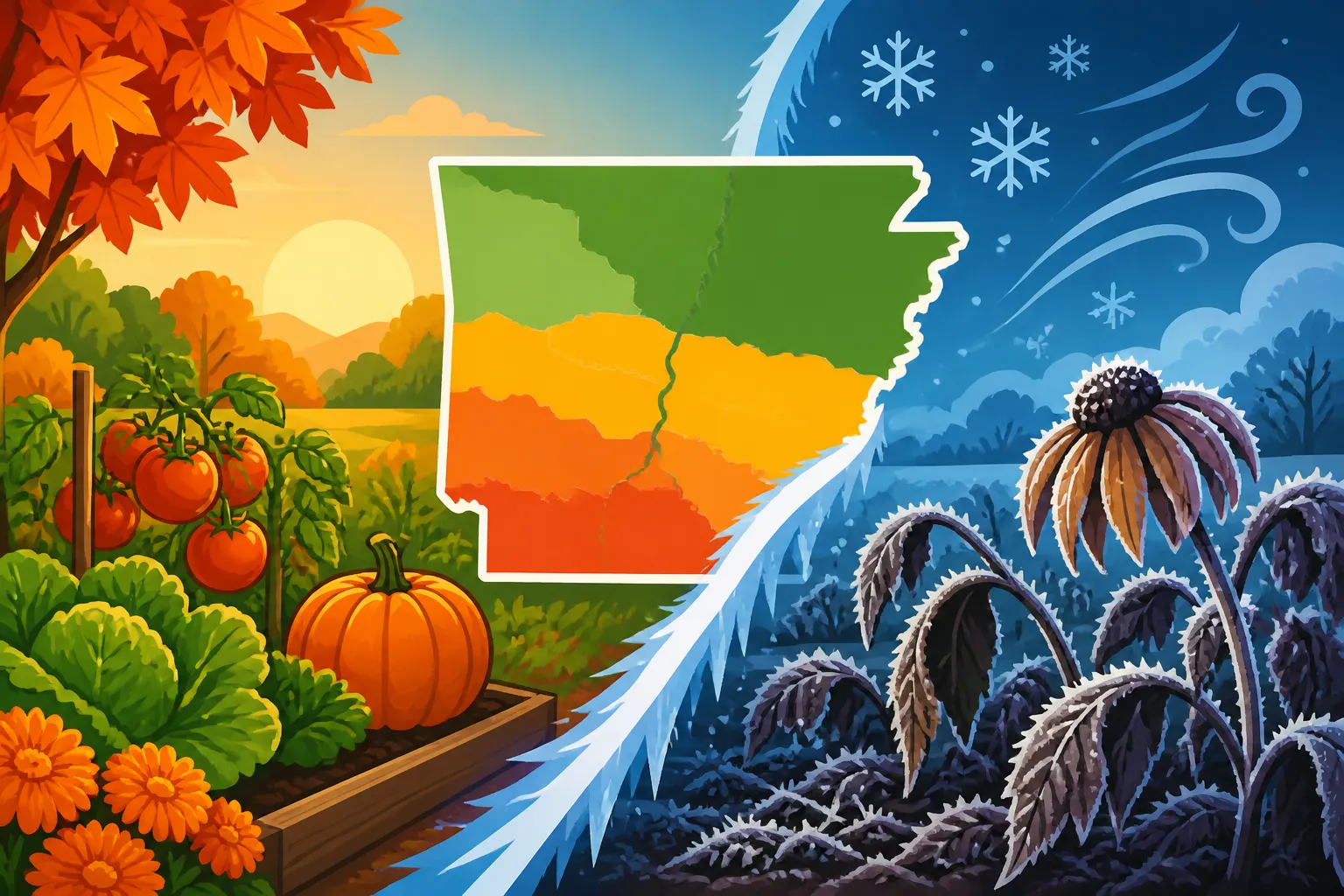
NOAA National Centers for Environmental Information lists different normal first fall freeze dates for the three Arkansas weather stations below. The station values show a difference in timing between these locations, but they should not be read as exact dates for every community or backyard nearby.
According to NOAA National Centers for Environmental Information, at the Little Rock weather station in Arkansas, the 1991–2020 normal first fall freeze (32°F) at 50% probability is 11/16 (November 16).
According to NOAA National Centers for Environmental Information, at the Fort Smith Regional Airport weather station in Arkansas, the 1991–2020 normal first fall freeze (32°F) at 50% probability is 11/06 (November 6).
According to NOAA National Centers for Environmental Information, at the Harrison Boone County Airport weather station in Arkansas, the 1991–2020 normal first fall freeze (32°F) at 50% probability is 10/30 (October 30).
| Weather station | How to use its normal | What it does not tell you |
|---|---|---|
| Little Rock | A reference point for planning around the station’s local pattern | The exact freeze date for every garden in the area |
| Fort Smith Regional Airport | A separate reference for comparing local timing | Whether a nearby garden will stay warmer or colder |
| Harrison Boone County Airport | A useful station point for planning in its vicinity | The coldest conditions in every nearby yard or low spot |
The station dates are useful for understanding that Arkansas does not have a single dependable first-freeze date. They are not interchangeable, and a station in one part of the state should not automatically stand in for a garden elsewhere. Even among gardens relatively close to a station, terrain, buildings, wind exposure, and the layout of the property can affect what plants experience.
The difference between a station normal and a local forecast matters most when you are deciding whether to leave a vulnerable crop exposed. Use the normal to think ahead: identify what you would protect, what you could harvest, and where you would move containers. When a cold night is approaching, check a current forecast rather than treating the normal as a warning for a specific date.
For timing by local area, How to Find Vegetable Planting Dates for Your Arkansas County can help you connect general scheduling to your county. For a closer look at regional weather patterns, see Regional Freeze Patterns: North, West, and South Arkansas. Keep in mind that a regional comparison still cannot replace the conditions in your own yard.
Why your garden may freeze before or after a station
A weather station is a consistent point of observation. A garden is a collection of small environments. The temperature around an exposed bed, a sheltered patio, a raised bed, and a low spot can differ during the same cold event. That is why a normal date is best treated as a starting point rather than a guarantee.
Low spots and cold-air movement
Cold air can collect in lower areas, especially where the landscape restricts its movement. A garden at the bottom of a slope or in a hollow may be more vulnerable than a nearby bed on higher ground. A spot that stays chilly on clear, calm nights deserves extra attention when tender plants remain outdoors.
Notice which parts of the yard tend to show cold damage first. Compare exposed beds with sheltered areas and low ground with higher ground. Repeated observations can help you identify the places where a protective cover or early harvest is most worthwhile. For more on this pattern, see Why Frost Pockets Form in Low Spots Across Arkansas Gardens.
Wind, walls, and exposure
Open areas may experience conditions differently from a bed protected by buildings, fences, or dense plantings. Shelter can reduce exposure, but it does not make a space immune to cold. A wall may provide some protection in one place while casting shade or changing air movement in another. Do not assume that a protected-looking corner will stay warm without observing it.
Container plants have their own risks. Pots are exposed on more sides than garden soil, and a container on an open patio may cool differently from roots planted in the ground. A movable pot gives you options: when a cold night is forecast, you may be able to shift it to a sheltered location or indoors if the plant can be handled safely.
Soil, moisture, and bed design
Soil conditions can affect how a garden responds to changing weather. Beds with different soil textures, drainage, and moisture may not behave alike. A raised bed is more exposed to surrounding air than the ground, while a poorly drained area may create other problems that affect plant health. Think about the bed’s situation rather than assuming every planting area responds in the same way.
Moisture is one factor in freeze preparation, but it is not a substitute for a cover or a current forecast. Avoid making sudden watering decisions based only on a normal date. Use sound watering practices for the crop and soil, and follow local guidance when a freeze is expected. The same attention to soil moisture is useful through the growing season; Checking Moisture Below the Surface Before Summer Garden Watering covers how surface appearance can differ from conditions below.
Crop stage and plant health
A vigorous plant may handle stress differently from a young, recently transplanted, wilted, or otherwise stressed one. A crop with fruit or blossoms that you hope to harvest may also need a different plan from a plant that is near the end of its useful season. The station date alone cannot account for any of these details.
Check the garden regularly as fall progresses. Look for fruit that has reached a usable stage, tender growth that would be difficult to replace, and plants that can continue producing through cooler conditions. A crop’s expected maturity time and its tolerance of cold are separate considerations. Calculating Arkansas Growing Season Length for Fall Crop Harvests can help with the broader question of whether a crop has enough time to mature.
How to plan garden work around freeze risk
A useful plan does not depend on guessing the exact night a freeze will occur. Instead, make decisions in stages: use the station normal to prepare, watch the forecast as conditions change, and respond according to the crops and places that matter most.
Identify what you want to save
Walk through the garden and sort plants by how much a freeze would matter to you. Tender vegetables with harvestable fruit may deserve attention before hardy greens or plants you are willing to let finish for the season. A few containers may be easy to move, while a large bed may call for harvesting or covering selected plants.
This is also a good time to check whether fruit is mature enough to pick. Harvesting before a cold event can preserve produce that would otherwise be damaged, but do not assume all unripe produce will ripen successfully after picking. For tomatoes that have reached mature-green stage, see Ripening Mature Green Tomatoes Indoors Before Freezing Weather. That option is specific to tomatoes and does not make an unripe harvest suitable for every crop.
If the garden includes crops planted for fall, use their cold tolerance and maturity stage to decide what needs attention first. A cool-season crop may continue after tender crops have finished, but the details depend on the crop and the conditions. When to Plant Cool-Season Crops and Fall Greens in Arkansas can help with the planting side of fall planning.
Prepare materials before a cold night is forecast
Keep appropriate covers available if you plan to protect plants. Covers need to be large enough to shelter the foliage and arranged so they do not crush plants. Secure them so they remain in place, and remove or adjust them when conditions allow. A cover can reduce exposure, but it cannot guarantee protection in every event.
Do not use a cover that is wet, heavy, or unsuitable for plants. Follow the instructions for any garden product you choose, and use care around heat sources or electrical equipment. If a plant is too large to cover effectively, harvesting its usable produce may be the more practical choice.
Containers are often easier to protect than in-ground crops. Grouping them in a sheltered place can simplify the task, but avoid moving plants into a setting that is unsuitable for their light or temperature needs for an extended period. If a container is heavy or fragile, plan its route and location before the weather turns.
For seedlings and young plants, preparation matters too. Newly established plants can be vulnerable even if they are expected to tolerate cooler conditions later. Moisture Care for Tender Seedlings in Arkansas Garden Beds offers related advice for keeping young plants in good condition.
Use the forecast for the immediate decision
As the season progresses, pay attention to forecasts for the location closest to your garden. Check for updates rather than relying on a forecast seen well in advance. If the forecast signals a freeze, act according to the plants you intend to protect and the amount of time available.
A forecast is still an estimate, and nearby conditions may differ. If your yard repeatedly freezes earlier than the nearest station or forecast suggests, use that local experience to be more cautious with exposed tender crops. If a protected bed usually stays warmer, do not treat that as proof it will remain safe; use the forecast and observe the actual conditions.
The choice to cover, harvest, move, or accept possible damage depends on the value of the crop and the effort involved. Cover plants you would be disappointed to lose, harvest produce that is ready, and avoid spending time protecting plants that are already at the end of their season unless there is a good reason to do so.
Keep a record for future seasons
A brief garden record can make the station normals more useful. Note when cold damage appears, which beds are exposed, which locations seem sheltered, and which crops were still producing. Record what you covered or harvested and whether the effort helped. These observations do not replace official weather information, but they can improve decisions in your own yard.
Keep station data and yard observations distinct. A station’s normal is a reference for its location; your notes describe your garden. Together, they can help you develop a practical response without treating a normal date as a promise.
Frequently Asked Questions
Does the 50% probability mean a freeze is likely on that exact date?
No. It is a normal date representing the midpoint of the station’s historical pattern, not a forecast for that particular day. A freeze can arrive earlier or later, so use a current forecast for immediate decisions.
Should I use the closest station date as my garden’s freeze date?
Use it as a reference, not a guarantee. Station conditions may differ from a yard because of elevation, exposure, buildings, and low spots. Your own garden observations can help you decide whether to act more cautiously.
Does the first freeze mean the whole garden will be killed?
Not necessarily. Plants differ in cold tolerance, and a first freeze does not affect every crop in the same way. Tender growth may be damaged while cool-season plants continue growing. Check the needs and condition of each crop.
What should I do when a freeze is forecast?
Prioritize tender plants and produce you want to save. Harvest what is ready, move containers when practical, and use suitable covers for plants you want to protect. Follow current local forecasts and adjust your plan to the conditions in your yard.
Sources
- NOAA National Centers for Environmental Information — NOAA NCEI 1991–2020 Climate Normals — Little Rock, Arkansas (checked November 14, 2026)
- NOAA National Centers for Environmental Information — NOAA NCEI 1991–2020 Climate Normals — Fort Smith Regional Airport, Arkansas (checked November 14, 2026)
- NOAA National Centers for Environmental Information — NOAA NCEI 1991–2020 Climate Normals — Harrison Boone County Airport, Arkansas (checked November 14, 2026)
Disclaimer
This article is for general informational purposes only and does not constitute professional advice. Laws, prices and regulations vary by location and change over time. Consult a qualified professional for guidance on your specific situation. Arkansas Gardening Guide is not a government agency and is not affiliated with any university extension, state department of agriculture or other government agency.